
Is a 2-Ton Jack Enough for My Car? The Weight Maths Every Overlander Needs to Do Before Their Next Trip
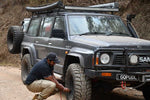

I want to tell you about a conversation I had at a trailhead a couple of years ago that's stuck with me ever since.
A bloke was fitting a spare tyre on his 200 Series Land Cruiser. His car had a full touring build — canopy, roof tent, dual battery, drawers, long-range tank, fridge, the lot. He had never given two thoughts about the jack. I asked him if he knew roughly how much his rig weighed fully loaded.
He said something like "Oh, about two and a half tonne, maybe three?"
Then I asked him how much weight he thought was sitting on that one rear corner of the vehicle.
He looked at me blankly. He'd never thought about it that way.
That's the gap this post is written to close. Because that bloke is not unusual. Most overlanders — experienced, well-equipped, thoughtful people who have spent serious money building their rigs — have genuinely never done the weight maths on their jack. They had the genuine jack and has thought it sounded plenty, and that was the end of the thought process. He hasn't worried two much about the jack as everything was new in his car and there was no consideration towards any on track fixes.
If you're loading up for a big trip and you're second-guessing whether your jack is up to the job, you're asking exactly the right question. Let's work through it properly.
First: The Dangerous Assumption Almost Everyone Makes
Here's the thing that surprises people when they hear it: when you jack a corner of your vehicle, you are not lifting the full weight of the vehicle. You're lifting roughly a quarter of it — one corner.
So on the surface, a 2-ton jack sounds generous for a 2.5-tonne vehicle. Quarter of that is around 625kg. A 2-ton (2,000kg) rated jack should have it covered with capacity to spare.
Except that calculation is wrong in almost every real-world touring setup, for two reasons.
Reason one: Your rig almost certainly doesn't weigh what you think it does.
A 200 Series Land Cruiser leaves the factory with a kerb weight of around 2,705kg and a GVM of 3,350kg. That gives you a theoretical payload of 645kg — the weight of all modifications, accessories, passengers, fuel, water, food, and gear combined.
Now add up a real touring build. A steel bullbar and winch runs around 60kg. A rear bar with second spare is another 70kg. An ARB drawer system in the back: around 60kg. A 60L fridge on a slide: 60kg. A roof rack: 30kg. A hard-shell rooftop tent: 70kg. Two adults: 150kg. A full long-range fuel tank: 120kg. A water tank: 80kg.
That's 700kg — and you haven't packed a single piece of camping gear, recovery equipment, food, or clothing yet. You're already over GVM before you leave the driveway.
More to the point: your loaded rig probably weighs closer to 3,200–3,400kg than the 2,500kg you estimated at the trailhead.
Reason two: Weight doesn't distribute evenly across four corners.
The "divide by four" assumption treats vehicle weight as perfectly balanced front-to-back and side-to-side. On a loaded touring rig, it isn't even close. Most of the heavy gear — the fridge, drawers, long-range tank, water, camping equipment — sits in the rear of the vehicle. The canopy or roof tent sits high and toward the back. This shifts a disproportionate amount of weight onto the rear axle.
On a heavily loaded 4WD with a full touring setup, it's not unreasonable for 55–65% of the total vehicle weight to be carried by the rear axle. That means each rear corner might be carrying 30% or more of the total vehicle weight — not the theoretical 25%.
On a 3,200kg loaded rig, 30% is 960kg. On a 3,400kg rig, it's over 1,000kg.
Your 2-ton jack is now working at 50% or more of its rated capacity. On a cheap, unrated jack — one that's stamped "2-ton" but was never independently tested — you're in genuinely uncertain territory. The rating may reflect ideal conditions in a factory setting, not a loaded 4WD parked on an off-camber gravel shoulder in the middle of a remote track.
That's the assumption that worries me. Not that people are buying 2-ton jacks. It's that they're buying cheap, unrated 2-ton jacks, putting them under the heaviest corner of their most loaded vehicle, in the worst possible ground conditions, and trusting a number on a sticker.
What Does "2-Ton Rated" Actually Mean — And Does Certification Matter?
This is the question that separates the gear that earns its keep from the gear that looks the part.
In Australia, jacks can be certified to Australian Standards — specifically AS3990:1993 (Mechanical Equipment – Steelwork) and AS2615:2016 (Hydraulic Trolley Jacks). These certifications require independent testing of the jack's capacity claims under standardised conditions.
A jack with these certifications isn't just rated by the manufacturer. It's been tested by an independent body and confirmed to perform to its stated specification.
The Pro Eagle 2 TON Big Wheel Off-Road Jack — "The Beast" carries both Australian certifications — AS3990:1993 and AS2615:2016. That matters enormously when you're putting it under the heaviest corner of a 3,200kg loaded rig on a remote track. You're not trusting a sticker. You're trusting a tested and certified 2,000kg capacity.
Cheap auto parts chain jacks almost never carry these certifications. Their capacity ratings are self-declared by the manufacturer. That doesn't automatically mean they're unsafe — but it means you have no independent verification that the number on the box reflects the actual failure point of the jack.
When you're working under a loaded vehicle, alone, on uneven ground, far from help, that distinction is not academic.
Why the Pro Eagle 2 Ton Big Wheel Is the Right Jack for Most Loaded 4WDs
Beyond certification, the Pro Eagle "The Beast" solves the specific problems that make generic trolley jacks fail in the field.
The floor jack design is inherently more stable than a bottle jack or vertical jack.
A floor jack's wide, low chassis spreads the load across a much larger footprint than a bottle jack or Hi-Lift style vertical jack. On an off-camber track surface — which is where you'll almost always be changing a tyre — that stability difference is significant. The Beast sits flat, rolls into position, and lifts without the lateral instability that sends vertical jacks tipping sideways under load.
The big wheels actually solve a real problem.
The Beast is built on Pro Eagle's 2-ton platform with strong solid axles and large non-pneumatic wheels — high-capacity, composite wheels with BF Goodrich KM3 tread. This isn't marketing. On a gravel track, a standard trolley jack's small rubber wheels dig in and lock up the moment you try to position it under the vehicle. On sand, they sink. The Beast's big wheels roll over rocks, roots, dirt, and debris to get into position without the usual wrestling match.
Non-pneumatic composite wheels with sealed ball bearings allow smooth rolling and operation even in dusty and sandy conditions. There are no pneumatic tyres to go flat when you need the jack most.
The full-length steel skid plate prevents the jack from sinking.
A full-length steel skid plate prevents sinking on sand and damage to internal components. This is the feature that separates an off-road jack from a workshop jack. On any soft surface — packed dirt, gravel, sand, even firm mud — a standard jack will start sinking before the vehicle rises. The skid plate distributes the load across the full length of the jack body, not just the feet.
The 8" extension is included — and a 15" extension is available for taller builds.
The Beast has a minimum height of 6" without the 8" extension and reaches up to 2'9" (33") with the optional 15" extension. For a standard-to-moderately lifted 4WD, the included 8" extension handles most tyre change situations. If your rig runs a significant lift and larger tyres — 33s or bigger — the optional 15" extension from recoverygear.com.au gives you the additional clearance to safely change a tyre without awkward, dangerous positioning of the jack.
The patented design comes with spare parts support.
Pro Eagle offers spare parts to keep your jack working for years, making it a true long-term investment. This matters more than most people realise. A cheap jack that fails on the second trip has no parts available to repair it. The Beast is a tool you can service and maintain, which means it stays in your kit for years rather than getting replaced every few seasons.
The Real-World Tyre Change Scenario on a Remote Track
Let me walk through what this actually looks like in the field — because the theory is one thing, the reality is another.
You're three days into a remote track, fully loaded, carrying food, water, and gear for a week. You pick up a sidewall puncture on the rear driver's side — the corner carrying the most weight, next to the long-range tank and directly under the canopy overhang. The track has a slight lean toward the driver's side.
Your options with a cheap 2-ton bottle jack:
- Find a flat spot to pull over (may not exist)
- Try to position the jack on uneven ground with a small, sinking foot
- Work in an off-camber position with a jack that becomes increasingly unstable as it extends
- Hope the capacity claims on the jack hold up under the actual corner weight of your loaded rig
Your options with the Pro Eagle 2 Ton Beast:
- Roll the jack into position over the rough ground without fighting it
- The skid plate distributes the load; the jack doesn't sink
- The wide chassis sits flat on off-camber ground
- The certified 2,000kg capacity gives you genuine headroom on that rear corner
- The extension adapts to your vehicle's height
- You change the tyre and drive out
It's the same scenario. It's a completely different experience.
Mounting: Don't Leave It Rattling Loose in the Back
One thing people sort out last — and shouldn't — is how the jack is stored and mounted in the vehicle.
A 52lb (approximately 23kg) piece of hydraulic equipment bouncing loose in the back of your 4WD is a projectile in any kind of sudden braking or off-road impact. Beyond the safety issue, it will damage everything around it, including itself.
The Pro Eagle 2 Ton Big Wheel Jack Mount is a stainless steel purpose-built mounting solution for the Beast. It holds the jack body, the handle, and has four pre-drilled mounting holes for bolting directly to the floor or a drawer system. The 2.0 version includes anti-rattle straps with laser-cut holes to significantly reduce noise and movement. Safety pin secures the jack to the mount so it can't shift even on rough terrain.
This is the right way to run the Beast in a touring setup — accessible, secure, and not destroying your gear or itself every time you drop off a ledge.
Do the Weight Maths on Your Own Rig
Before your next trip, I want you to actually do this exercise. It takes ten minutes and it might change how you think about your jack selection permanently.
- Find your vehicle's kerb weight — this is in your owner's manual or on the manufacturer's website. For most 200 Series LandCruisers it's around 2,700kg. For a Prado 150, closer to 2,200–2,300kg. For a Patrol Y62, around 2,450–2,600kg depending on variant.
- Add up your modifications and fixed accessories — bullbar, winch, rear bar, drawers, roof rack, long-range tank, dual battery. These are the things on the vehicle permanently, regardless of whether you're loaded for a trip.
- Add your trip load — rooftop tent or camping setup, fridge and contents, food and water, recovery gear, passengers. Be honest. A full fridge, two passengers, and a week of provisions adds up faster than you expect.
- Now calculate your rear axle load — if your build is rear-heavy (canopy, fridge, drawers), assume 55–60% of total weight on the rear axle. Divide that by two for a rear corner load.
- Compare that number to your jack's certified capacity — not its sticker rating, its certified capacity.
If that corner load is approaching 800–900kg on a heavily loaded rig, a certified 2-ton (2,000kg) jack like the Pro Eagle Beast gives you a reasonable safety margin. An uncertified "2-ton" budget jack gives you a sticker and a hope.
The Honest Answer to "Is a 2-Ton Jack Enough?"
For most standard-to-moderately loaded 4WDs — Prados, mid-spec 200 Series, Everests, Patrols without extreme touring builds — a certified 2-ton jack like the Pro Eagle Beast from recoverygear.com.au is genuinely sufficient. The maths works, the certification is there, and the off-road specific design handles the real-world conditions that generic jacks can't.
For extremely heavy builds — maximally loaded 200 Series, heavily accessorised full-size Patrols, vehicles with significant bar work, canopy, water tanks and a full touring load — step up to the Pro Eagle 3 Ton Kratos. The additional capacity gives you genuine headroom on the heaviest rear corner loads, and the Kratos carries the same off-road design DNA as the Beast.
Do the maths. Buy the right tool. And for the love of your safety, mount it properly.