
Is a Hi-Lift Jack Worth It for Off-Road Adventures? Here's My Honest Answer After One That Almost Went Very Wrong.

I'll answer the question in the title straight away: a Hi-Lift jack is worth it — if you already know exactly what you're doing with one and your vehicle is set up specifically to use it.
For everyone else? There are better options. Safer options. Options that will actually get you out of trouble instead of adding to it.
Let me tell you what changed my thinking.
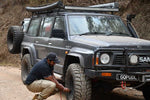
I was doing a tyre change on a high country track. Nothing dramatic — a sidewall puncture on a rocky section, annoying but routine. I've done it a hundred times. I set the Hi-Lift against the vehicle's step bar, started working the handle, got the wheel off the ground, and then the jack shifted. Not catastrophically — it didn't fall — but it kicked sideways enough that the handle whipped back and caught me across the forearm hard enough to leave a bruise that took two weeks to fade. The vehicle rocked, the wheel dropped a few centimetres, and I stood there for a moment just breathing.
Nobody was hurt. The vehicle was fine. But it was a sharp reminder that the Hi-Lift jack is a tool that operates in a very small margin of error — and that margin gets even smaller when you're working on uneven, off-camber ground with a loaded 4WD and no one around to assist.
That experience sent me down a rabbit hole of research, and eventually toward two jacks that I now consider the smarter choice for most 4WDers: the ARB Hydraulic Jack and the Pro Eagle Big Wheel Off-Road Jack. Both are stocked at recoverygear.com.au and both solve — in different ways — the core problems the Hi-Lift has.
This post lays out exactly what those problems are, who the Hi-Lift actually suits, and which jack you should be looking at instead.
What Makes the Hi-Lift So Popular — And Why That Popularity Is Partly a Problem
The Hi-Lift has been around for over 100 years. It's cheap relative to alternatives, it's versatile (it can technically be used as a winch, spreader, and clamp), and it looks serious on a roof rack or a bull bar. Half its popularity is functional. The other half is aesthetic — it's become a symbol of serious off-road credibility.
The problem is that credibility and capability aren't the same thing. A Hi-Lift jack is a mechanical ratcheting farm jack. It was designed for use in fields and on farm equipment — relatively flat ground, controlled environments, experienced operators. When you take it off a farm and use it on a steep, soft, rock-strewn bush track with a heavily loaded 4WD and an anxious driver, you're operating well outside those design assumptions.
The specific dangers, based on my own experience and the accounts of recovery professionals I've worked alongside:
Handle kickback. The cast-iron reversing mechanism on a Hi-Lift requires you to manually flip a lever to switch between up and down modes. If that lever isn't fully engaged, or if you've slightly misjudged the load while transitioning, the handle can kick back with significant force. This is the mechanism that bruised my arm and has broken wrists and fingers for others who weren't as fortunate with the geometry.
Instability under load. A Hi-Lift jack supports the vehicle on a single relatively small foot. On flat, solid ground, that's manageable. On an off-camber track surface, on soft ground, or on gravel that moves under load, the jack can shift laterally while the vehicle is lifted. A vehicle that comes down off a jack unexpectedly on a slope is a serious incident.
Unsuitable attachment points on modern 4WDs. The Hi-Lift was designed to hook into vehicle body panels and step bars. Modern 4WDs — particularly those with plastic cladding, recessed bumpers, or flush body panels — often have no safe lifting point for a Hi-Lift without a dedicated adapter. Attempting to lift a modern vehicle without correct attachment can crush the bodywork, damage the attachment point, or cause the jack to slip under load.
No overload protection. A Hi-Lift has no blow-off valve, no overload mechanism, nothing to prevent the user from exceeding the rated load. If you're lifting a heavily loaded 4WD and you've miscalculated the weight, the jack simply keeps going until something fails.
None of this makes the Hi-Lift a bad tool in the right hands. But the right hands are rarer than the number of Hi-Lifts on roof racks would suggest.
What You Actually Need a Jack For — And What That Means for Your Choice
Before recommending anything, it's worth being clear about the job. Most drivers buying a jack for off-road use need it for one or more of these situations:
Tyre changes on uneven, soft, or unstable ground. This is the most common real-world use by a long stretch. Your factory bottle jack won't work on a sloped track, in mud, or on ground too soft to support it. You need something that can be positioned accurately, lift high enough to clear a 4WD's wheel well, and stay stable while you work.
High-centring recovery. When your chassis is resting on a rock or mound and the wheels are off the ground, you need to lift the body and pack material underneath the tyres to regain traction. This requires controlled, precise lifting — exactly the scenario where an unstable jack is most dangerous.
Off-camber or lean situations. When a vehicle is leaning toward a drop, a jack is sometimes the only tool that can reposition it. This is technical work that requires a jack with excellent stability and smooth, controlled operation.
For all three of these situations — but especially for tyre changes, which is where most people will actually use their jack — the ARB Hydraulic Jack and the Pro Eagle Big Wheel Jack are both meaningfully better tools than a standard Hi-Lift.
Option 1: The ARB Hydraulic Jack — The Smarter Mechanical Solution
ARB built their hydraulic jack specifically to solve the Hi-Lift's problems. Their engineers looked at the farm jack design and asked a simple question: what if you kept the long-travel lifting capability but replaced the manual ratchet mechanism with hydraulics?
The result is a jack that lifts via a hydraulic cylinder with each pump of the handle, rather than through a reversing ratchet. What this means in practice:
No handle kickback. The hydraulic mechanism doesn't have the same reversal lever failure mode. The handle operates smoothly up, and lowering is controlled through a dedicated red lever with a two-stage descent (slow or fast) and a safety stop. You're in control of the rate of descent at all times.
Smooth, controlled lifting. Each downward stroke of the handle raises the vehicle in 13mm increments. It's progressive, manageable, and easy to stop and assess at any point — unlike the Hi-Lift, where you're committed once you start working.
Built-in overload protection. When under load, an internal blow-off valve provides overload protection to safeguard both the jack and the user from the dangerous consequence of the vehicle suddenly dropping if the working limit is exceeded. This is the safety feature the Hi-Lift fundamentally lacks.
Aircraft-grade construction. The body is made from aircraft-grade 6061 T6 aluminium for maximum strength — it's substantially lighter than a Hi-Lift jack despite similar lifting capacity, which matters when you're manoeuvring it into position under a vehicle on uneven ground.
Nine hooking points. The adjustable hook gives you multiple lifting positions up the body of the jack, making it adaptable to different vehicle heights and lifting points — genuinely useful given the variety of 4WD setups in Australia.
The ARB Hydraulic Jack 48" (2,000kg capacity) is the standalone unit. For tyre changes and recovery work on soft or uneven ground, the non-negotiable companion is the ARB Jack & Base Bundle, which pairs the jack with the ARB Jack Base — a heavy-duty high-density polyethylene base plate rated to 7,000kg with a non-slip textured surface. It provides a sturdy surface during recovery missions to limit slippage or sinking into soft ground. Without the base, you'll sink into mud or sand before the vehicle lifts. It also mounts on top of ARB TRED Pro boards, which is a genuinely useful design detail for beach and soft-ground work.
The ARB Jack is the right choice if you want the long-travel lifting capability of a Hi-Lift — the kind of height needed for high-centring recovery or wheel changes on heavily lifted 4WDs — but with the safety and control of hydraulics.
Option 2: The Pro Eagle Big Wheel Off-Road Jack — Born From Racing, Built for the Field
The Pro Eagle is a different design philosophy entirely. Where the ARB Jack is a vertical jack (like the Hi-Lift), the Pro Eagle is a floor jack — the same type of trolley jack you'd use in a workshop — redesigned from the ground up for use on rough terrain.
Built on a robust chassis, it features solid axles and large non-pneumatic wheels that effortlessly navigate rough terrain and obstacles such as sand, dirt, and debris. The full-length steel skid plate prevents sinking on soft surfaces. This is the fundamental advantage over a workshop floor jack, which would simply sink into the first piece of soft ground it encountered.
Pro Eagle's range at recoverygear.com.au includes:
2 TON Big Wheel Off-Road Jack — "The Beast" — the more accessible entry point, suited to most standard 4WDs and touring vehicles. Comes with an 8" extension included.
3 TON Big Wheel Off-Road Jack — "The Kratos" — the heavyweight of the lineup, with a 3-ton hydraulic capacity and the same big-wheel chassis for rough terrain mobility. Trusted by race teams, with BFGoodrich relying on Pro Eagle jacks for years in their Pit Support program, pushing limits in the toughest conditions.
Why does a floor jack design matter for off-road use?
Stability. A floor jack's wide, low chassis is inherently more stable than a vertical jack standing upright under a vehicle. On off-camber ground — the scenario that bit me with my Hi-Lift — a floor jack sits far more securely. There's no single-point foot under a loaded vehicle. The weight distributes across the full chassis footprint.
Speed. Getting a tyre changed quickly matters when you're on a road with no shoulder, when the tide is coming in, or when afternoon weather is building. A hydraulic floor jack is significantly faster to operate than a ratchet or hand-pump vertical jack.
No attachment point limitations. A floor jack lifts from underneath the vehicle via the chassis, axle, or dedicated jack points. Modern 4WDs with plastic bumpers and flush bodywork that can't safely engage a Hi-Lift hook are no problem for a floor jack — every vehicle has an underside you can jack from.
No kickback risk. This is the one that matters most to me after my experience. A floor jack has no reversing lever mechanism. There's no handle kickback scenario. You pump to raise, engage the valve to lower. The failure modes that make Hi-Lift jacks genuinely dangerous simply don't exist.
The 15" Extension is worth noting for lifted 4WDs — with the supplied 8" extension, the Kratos achieves a maximum lift height of 2'4" and up to 2'11" with the optional 15" extension. For a standard-height 4WD, this is more than sufficient for wheel changes and most recovery situations.
The tradeoff with the Pro Eagle is bulk. It's heavier and takes up more space than either a Hi-Lift or the ARB Jack. For a daily driver with a full recovery build and dedicated storage (drawers, slide-out systems), it's a perfect fit. For a more minimalist setup where every kilogram counts, the ARB Jack may be the better trade.
So — Where Does the Hi-Lift Actually Make Sense?
I want to be fair here, because I don't think the Hi-Lift deserves to be written off entirely.
The Hi-Lift is genuinely useful for winching and clamping applications that the ARB Jack and Pro Eagle can't replicate. If you need to use a jack as an improvised winch — attaching the clamp head to a rated recovery point and using the handle to drag a vehicle sideways — the Hi-Lift is the only tool in this comparison that can do it.
It also suits older 4WDs with solid steel bumpers and body rails that were designed with Hi-Lift use in mind. On a classic Land Cruiser with a steel bull bar and proper side steps, the Hi-Lift hooks up cleanly and works exactly as intended.
And for drivers who have done proper training with a Hi-Lift — who can operate the reversing mechanism without thinking, who know how to position the foot, who understand the instability and account for it — it remains a capable piece of recovery kit.
The Hi-Lift Jack X-treme (available at recoverygear.com.au) with its 1,050kg capacity is the quality end of the Hi-Lift range, and if you're determined to run one, the Hi-Lift Off-Road Base is non-negotiable to prevent foot sinkage on soft ground. But understand what you're getting and what you're working around.
The Decision Framework: Which Jack Is Right for You?
Buy the ARB Hydraulic Jack + Base Bundle if:
- You want Hi-Lift-style long travel lifting with genuine hydraulic safety
- You're doing high-centring recovery as well as tyre changes
- Weight and compactness matter (it's lighter than a Pro Eagle)
- You want overload protection built into the mechanism
- Your 4WD has a body or bumper that the hook can safely engage
Buy the Pro Eagle Big Wheel Jack if:
- Stability is your primary concern — especially on off-camber or uneven ground
- You have a modern 4WD with limited Hi-Lift attachment points
- Speed of operation matters
- You have dedicated storage (drawer system, slide-out) to manage the extra bulk
- You want the same jack race teams and professional pit crews trust
Consider the Hi-Lift if:
- Your vehicle is specifically set up for it (steel bull bar, raised body rails)
- You've done hands-on training with one and are comfortable with the mechanism
- You need the winching/clamping functionality that the other jacks don't offer
- You pair it with the Off-Road Base and understand its limitations
The Bottom Line
The Hi-Lift Jack has been in 4WDing culture for so long that people buy it without really questioning whether it's the right tool for their vehicle and their situation. A lot of the time, it isn't.
The ARB Hydraulic Jack and the Pro Eagle Big Wheel Jacks represent a genuine step forward in both safety and usability. They cost more — but they address the specific failure modes that have caused real injuries with Hi-Lift jacks for decades. ARB's own engineers designed the ARB Jack specifically to solve the unsafe farm jack problem, focused on building a safer and easier mechanical jack while being lighter and more compact.
If you're heading to recoverygear.com.au to buy a jack for the first time, start with those two options before defaulting to the Hi-Lift out of habit or because it looks the part on a roof rack.
Buy the tool that gets you home safely. The best jack is the one that works without incident every single time you use it.